
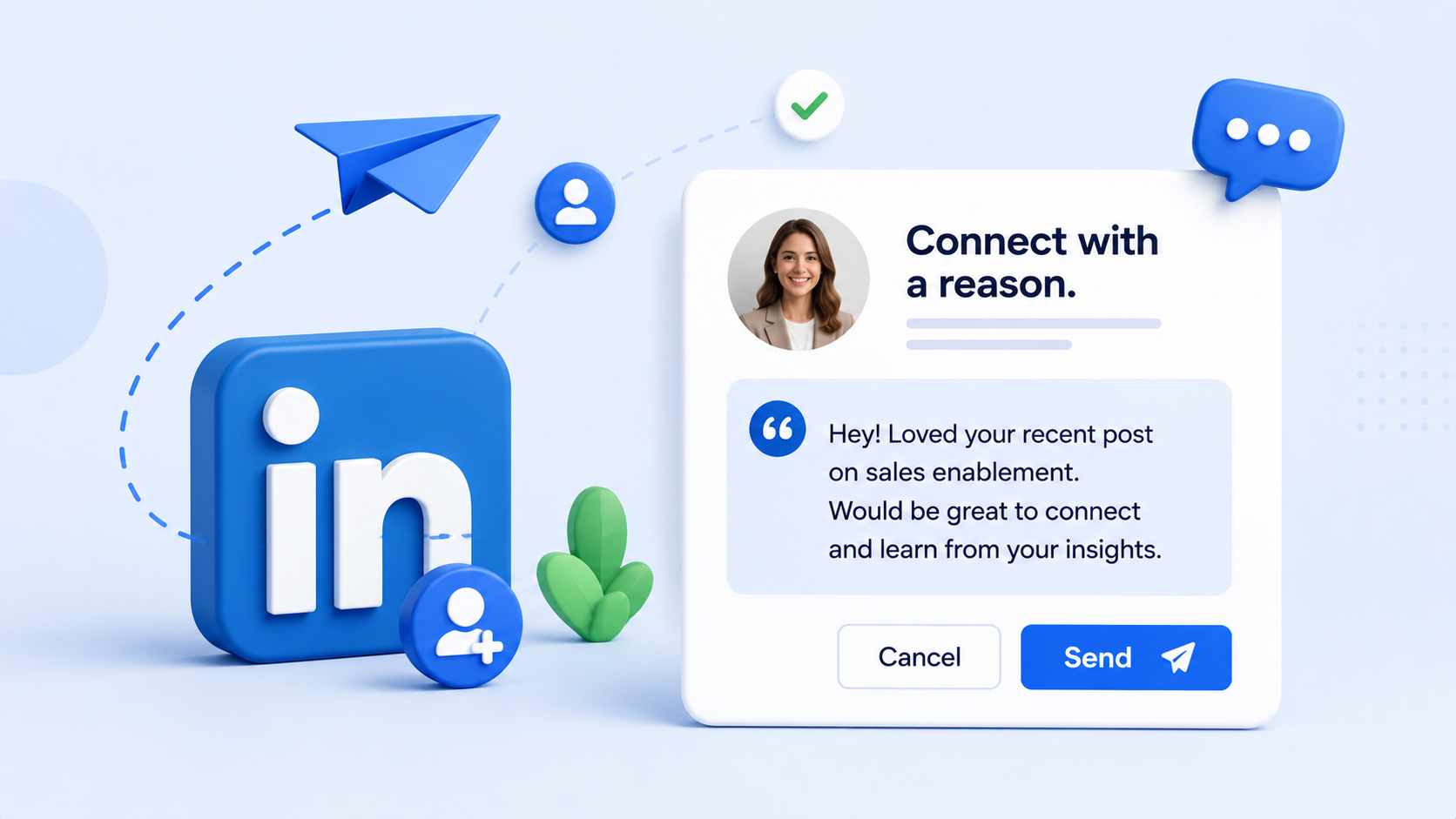

Most LinkedIn connection request messages get ignored in 2026, not because the sender is a bad fit, but because the message gives the recipient no reason to accept. The default approach, whether no message at all or a generic "I'd like to add you to my professional network", treats a connection request like a social media follow. In B2B, it is not. A LinkedIn connection is the start of a conversation, and the request message is the opening line. It should earn a yes.
This post covers why most requests fail, what the good ones have in common, and 25+ templates you can actually use for the situations you will encounter every week.
Why Most LinkedIn Connection Request Messages Get Ignored
Three patterns account for most ignored or declined requests.
No context. A blank connection request with no note asks the recipient to accept without knowing anything about why you are reaching out. For prospects who are selective about their network, blank requests from strangers default to decline.
Immediate pitch. A connection request that opens with "I noticed you're dealing with X problem and I'd love to share how we solve it" is not a connection request. It is a cold message disguised as one. Recipients recognise this immediately.
Generic flattery. Messages like "I've been following your work and really admire what you're doing" land as templates. If the same compliment could be sent to any person in any industry, it reads as copy-paste and produces no trust.
The common thread is that none of these give the recipient a specific reason to say yes. A good connection request does one thing: gives the recipient a credible reason to want you in their network, specific enough that it could not have been sent to anyone else.
What Makes a LinkedIn Connection Request Message Work
Keep it short. LinkedIn caps connection request notes at 300 characters, which is roughly two to three sentences. That constraint is useful. It prevents people from cramming in a full pitch and makes the message feel lightweight to receive.
Do not ask for anything. The request is not the place to book a call, request a meeting, or pitch your product. Those things can come after acceptance. The message should make accepting feel like a natural, low-effort decision.
Anchor to something real. A post they wrote, a company milestone, a shared connection, a piece of content they engaged with. Something that could not have been sent to five hundred other people on the same day.
25+ LinkedIn Connection Request Message Templates for Every Situation
These are starting points, not scripts. The personalised detail in brackets is what makes them work. Skip it and they read like every other request in someone's inbox.
When They Have Posted Content on LinkedIn
These open best because the prospect immediately senses the message was not sent to a list.
- "Hey [name], your post on [specific topic] was one of the more honest takes I've read on it. I work on [relevant problem], would be good to have you in my network."
- "Hey [name], saw your take on [topic] and you made a point that not many people are willing to say out loud. Work in a similar space, would be good to connect."
- "Hey [name], saw your comment on [person]'s post about [topic]. You made a good point. I work in the same area, thought it was worth connecting."
- "Hey [name], your post on [pain point] resonated, it's something I hear from a lot of [role] teams. Would be good to have you in my network."
- "Hey [name], just read your article on [topic]. The section on [specific point] was useful. I work on [related area], would be good to connect."
The strongest one: the first. "Your post on [specific topic] was one of the more honest takes I've read on it" is a real observation that could not have been sent to anyone else. It completes a thought before asking for anything.
Example: "Hey Sarah, your post on SDR ramp time was one of the more honest takes I've read on it. I work on outreach tooling for sales teams, would be good to have you in my network."
When There Is a Company or Timing Signal
Signals give you a reason to reach out that is not about you. The message acknowledges something that is true of them right now, not something generic about your product.
- "Hey [name], congrats on the [Series X] raise, saw the announcement. We work with a few teams at this stage on [problem]. Would be good to connect."
- "Hey [name], noticed [company] just launched [product/feature]. Interesting direction. I work with teams building in this space, would be good to connect."
- "Hey [name], noticed [company] is scaling the [sales/marketing] team, congrats on the growth. We work with teams going through the same stage. Worth connecting."
- "Hey [name], saw you just joined [company], congrats on the new role. I work with [role] teams at companies like yours. Would be good to connect as you get settled in."
- "Hey [name], congrats on the [new title] at [company]. I work with people in similar roles on [relevant area], would be good to have you in my network."
- "Hey [name], saw that [company] is expanding into [market/region]. We work with teams navigating that exact stage. Worth connecting."
The strongest one: the job change template. Someone new to a role is actively orienting themselves and open to conversations that are relevant to where they are now. The timing is real and they know it.
Example: "Hey James, saw you just joined Deel as VP of Sales, congrats on the new role. I work with VP-level sales teams on multi-channel outreach. Would be good to connect as you get settled in."
When You Have a Shared Connection or Context
Borrowed trust is still trust. A mutual connection reference cuts through in a way that cold outreach cannot replicate.
- "Hey [name], [mutual connection] mentioned you'd be worth connecting with. I'm working on [brief description], seems like there could be some overlap. Happy to connect."
- "Hey [name], we're both in [LinkedIn group / community]. I've found your contributions there useful. Work on [related topic], would be good to connect outside the group."
- "Hey [name], looks like we were both at [event] recently. I work on [relevant area], would have been good to connect in person. Happy to do it here instead."
- "Hey [name], noticed we both know [person]. I work on [area relevant to them], would be good to have you in my network."
The strongest one: the mutual connection referral. Use it only when the mutual connection genuinely knows you. A name-drop from someone who barely knows you can backfire if the recipient follows up with them.
Example: "Hey Priya, Rohan Mehta mentioned you'd be worth connecting with. I'm building outreach tooling for B2B sales teams, seems like there could be some overlap. Happy to connect."
Direct and Honest Outreach
This category works better than most people expect. Directness reads as confidence and most prospects respect it more than a request that is pretending not to be outreach.
- "Hey [name], I'll be upfront: I build outreach tooling for B2B sales teams and your profile fits the kind of person who tends to find it useful. Thought it was worth connecting."
- "Hey [name], I work with [role] teams at [company type] on [problem]. Your background is a good fit for what I do. Happy to connect."
- "Hey [name], building in a similar space to you. Always useful to connect with other founders working on [adjacent problem]. Would be good to have you in my network."
- "Hey [name], I work with outbound agencies specifically on [problem agencies face]. Looks like you're running [agency], would be good to connect."
The strongest one: the first. It leads with the honest reason and acknowledges the commercial intent without hiding it. Most people who match the ICP respect the transparency.
Example: "Hey Marcus, I'll be upfront: I build multi-channel outreach tooling for B2B sales teams and your profile at HubSpot fits the kind of person who tends to find it useful. Thought it was worth connecting."
For Role-Specific Outreach
When your ICP is a specific role, the message can reference what that role deals with in a way that feels relevant rather than generic.
- "Hey [name], I work with SDR teams specifically on [outreach problem]. Saw you're doing outbound at [company], would be good to connect and swap notes."
- "Hey [name], I work with VP-level sales leaders on [specific challenge]. Your background at [company] stood out. Would be good to connect."
- "Hey [name], I work with founders running their own sales motion, at a specific stage most tools aren't built for. Your profile came up and seemed like a good fit."
- "Hey [name], I work with recruiting teams on [relevant problem]. Saw you're at [company], would be good to connect and see if there's any overlap."
- "Hey [name], I work with RevOps leads on [problem]. Your background spans both ops and go-to-market, which is the exact combination that tends to find what we build useful."
The strongest one: the RevOps one. It identifies a specific signal in their background and uses it as the hook, which is more credible than just referencing their title.
Example: "Hey Nina, I work with RevOps leads on outreach data quality. Your background spans both ops and go-to-market at Salesforce, which is the combination that tends to find what we build useful."
For Re-engagement
When there is prior context, whether a lapsed connection, a profile view, or a previous conversation, you have a reason to reach out that is more credible than cold outreach.
- "Hey [name], we connected a while back and I've been following what you're building at [company]. Wanted to reconnect properly. Still working on [your area], happy to catch up if useful."
- "Hey [name], reached out by email recently but figured LinkedIn might be easier. I work on [relevant area], would be good to connect here instead."
- "Hey [name], noticed you came across my profile. I work on [area]. If anything caught your eye, happy to connect and chat."
- "Hey [name], we spoke briefly at [event] about [topic]. Good to connect here so we can continue the conversation."
The strongest one: the profile view follow-up. They have already signalled something: they looked at you. The message acknowledges that without being strange about it, and gives them a low-effort way to move forward.
Example: "Hey Tom, noticed you came across my profile. I work on AI-native outreach tooling for sales teams. If anything caught your eye, happy to connect and chat."
What to Do After They Accept
Accepting a connection request does not mean someone is ready to buy or even ready to have a conversation. What you do in the days after acceptance determines whether the opportunity develops or dies.
Do not send a pitch within the first 24 hours. This is the most common mistake and it erodes whatever goodwill the connection request built. The person who just accepted is signalling openness to a conversation, not a proposal.
Send a short follow-up two to three days after acceptance. Reference the reason you connected. Ask one easy question, something about their current approach or a challenge relevant to what you do. Keep it conversational.
If they respond, you are in a real conversation. If they do not respond after two attempts over the next two weeks, move on. Continuing to message non-responders damages the relationship before it starts.
toflow.ai automates this follow-up layer: tracking acceptance, then sending the follow-up message at the right interval, without requiring you to manage each contact manually.
How to Personalise at Scale
Writing a bespoke message for every prospect is not realistic at volume. The practical approach is a template with one genuinely personalised element: a post they wrote, a company signal, a shared connection.
The research is the part that takes time. toflow.ai reads prospect profiles and recent LinkedIn activity, identifies the most relevant personalisation hook for each person, and generates the connection request message automatically. The personalisation is real: it references what the prospect actually posted or did, without requiring you to manually research every profile. The Chrome extension lets you trigger this directly from LinkedIn while browsing.
Book a demo and we will walk through how the LinkedIn connection and follow-up workflow runs live.
Frequently asked questions
What are the best LinkedIn connection request message templates in 2026? The highest-performing templates reference something specific to the recipient: a post they wrote, a company milestone, or a mutual connection. Generic templates that could be sent to anyone consistently underperform. The 25+ templates above cover the most common situations: content engagement, company signals, shared connections, direct outreach, role-specific targeting, and re-engagement.
How long should a LinkedIn connection request message be? Two to three sentences. Long messages read as pitches, which reduces acceptance rates. The goal of a connection request is to get accepted, not to sell. Save the full context for after the conversation starts.
What is the LinkedIn connection request character limit? LinkedIn limits connection request notes to 300 characters, roughly two to three short sentences. That constraint works in your favour. It prevents over-explaining and keeps the message lightweight to receive.
Should I send a LinkedIn connection request without a message? Only if your profile is strong enough to stand alone and the recipient already recognises your name. For cold outreach to prospects who do not know you, a blank request consistently underperforms a short, specific note.
Book a demo now. Two weeks free trial, no credit card required.