
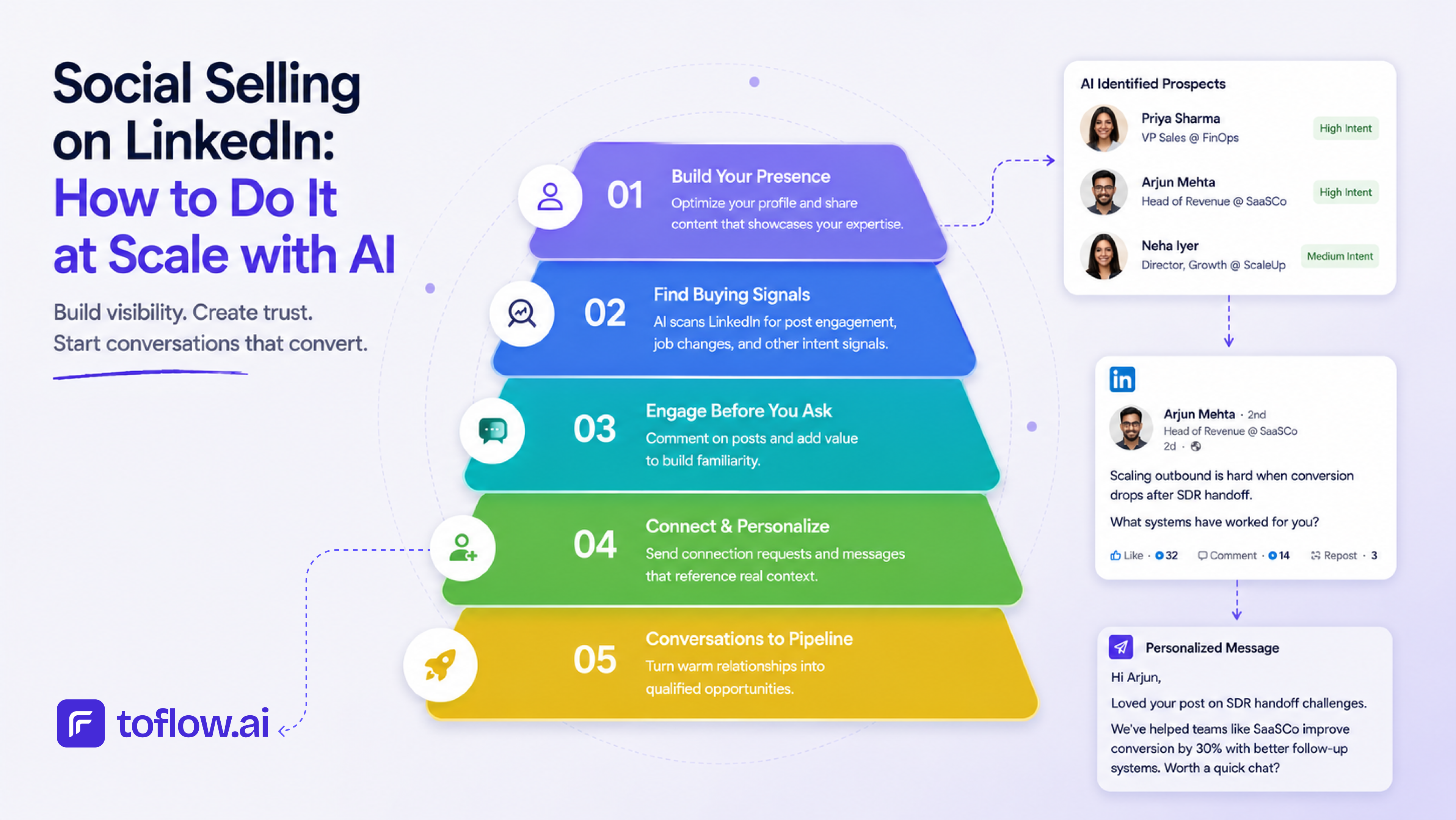

Social selling on LinkedIn is not LinkedIn outreach with a softer name. It is a different motion. Cold outreach starts with a message to someone who does not know you exist. Social selling starts earlier, building enough familiarity that when you do reach out, the person on the other end already has some context for who you are.
The practical difference shows up in response rates. A connection request from someone a prospect has seen commenting on their posts or engaging with their content lands differently than one from a complete stranger. You are not asking for attention. You are continuing something that already started, even if only in the prospect's peripheral vision.
In 2026, AI changes what is practical in this motion. Reading prospect signals at scale, knowing who to engage with and when, personalising based on actual activity rather than profile data alone. These are the parts of social selling that used to cap out at a handful of carefully managed accounts. This post covers how the approach works and where AI fits.
What social selling on LinkedIn actually means
Social selling is using LinkedIn to build genuine familiarity with prospects before asking for anything. The core idea is that salespeople who are visible and credible in a buyer's world before reaching out get a different reception than those who appear cold.
It rests on three things:
Your presence is what a prospect sees when they look you up. A profile that reads like a job application does nothing for social selling. A profile that clearly communicates who you help and what perspective you bring is the difference between a prospect thinking "sales rep" and thinking "someone worth talking to." Content you publish reinforces this. Consistent, relevant posts make you a recognisable name in someone's feed before you ever start a conversation.
Their signals are what their LinkedIn activity tells you about timing and priorities. What a prospect posts and engages with reveals what they are thinking about. A VP of Sales who spends a week commenting on posts about pipeline efficiency is telling you something about their current problem. That signal is far more valuable than knowing their job title and company size. It tells you what to say and, more importantly, when to say it.
The warm transition is the move from observer to contact at the right moment. Social selling does not mean waiting indefinitely before reaching out. It means reaching out when there is something real to reference, ideally after some form of visible engagement, so the connection request does not land cold.
Reading signals before you engage
The most important thing social selling requires is knowing which prospects to focus on and when. You cannot engage meaningfully with hundreds of people simultaneously. The ones worth prioritising are the ones who are actively thinking about something related to what you solve.
LinkedIn post engagement is the clearest real-time signal available. When someone in your target market comments on a post about a problem your product addresses, they are in-market in a way that a database record cannot capture. That comment tells you more about their current priorities than their job title does.
toflow.ai reads LinkedIn post engagement directly. Paste a URL of a relevant post (a competitor's announcement, an industry report, a thought leader your buyers follow) and toflow pulls the list of people who commented or reacted, filtered by your ICP criteria. The AI enrichment agent then reads each person's recent posts and activity before you engage, so you know what else they have been thinking about, not just that they reacted to one post.
Claude or ChatGPT, connected to toflow through toflow.ai/connect-mcp, can run this in a single instruction. You describe what kind of signal you are looking for, and the AI surfaces the right prospects, already enriched, with their recent activity read.
Other signals worth tracking: a prospect publishing their own post about a problem you solve (they are raising their hand), a job change into a role that buys your product (first 60-90 days is the highest-intent window), and a company expanding a team your product serves.
Engaging before the connection request
The engagement step is where most people skip straight to the message and wonder why social selling does not work for them. Genuine engagement, a considered comment on a post they published, a reaction that shows you actually read what they wrote, creates the familiarity that makes the connection request land differently.
This does not need to be elaborate. A comment that adds a perspective or acknowledges a specific point they made is enough. The goal is not to impress them. The goal is to be a recognisable name before the connection request arrives.
The Chrome extension lets you capture a prospect directly from their LinkedIn profile as you engage, adding them to your toflow list without switching tools. You can add a note on what you engaged with, so when the connection request goes out later, the AI has that context to reference.
Social selling on LinkedIn: the warm transition to outreach
After genuine engagement, the connection request is not a cold ask. It references something real. The note is short, under LinkedIn's 300-character limit, and specific. Not "I'd love to connect" but something that shows you paid attention to their content or their situation.
toflow.ai generates this note per person from their actual LinkedIn activity. The AI reads their recent posts, what they have been engaging with, and any company signals, and writes a connection note that references something specific to them. The note is generated fresh at the point of sending, not adapted from a shared template.
Connection status is checked automatically before anything goes out. If a prospect is already a first-degree connection, toflow skips the connection request and moves directly to a message. If they are unconnected, the connection request goes first. The routing happens without manual sorting on your end.
Once connected, the follow-up message continues the same thread rather than starting over. It references what prompted you to connect in the first place. This is where the social selling motion converts into a real conversation.
Book a demo and we will walk through how to set up the full signal-to-conversation workflow for your ICP.
Where your own content fits
Social selling also works inbound. When prospects engage with content you publish, they are signalling something. A comment on your post, a reaction to something you shared, a visit to your profile after you post. These are warm signals that most salespeople ignore because they have no system for acting on them.
toflow.ai treats inbound LinkedIn engagement as a trigger. When someone from your target market engages with your content, that person can be added to a prospecting workflow automatically. They already know who you are. The outreach that follows is not cold. It is a response to something they already initiated.
This is covered in more depth in inbound-led outbound, which covers how to build a system around inbound signals across LinkedIn and other channels.
What AI changes about social selling at scale
The traditional limit of social selling is that doing it properly, reading signals, engaging genuinely, personalising each connection note, takes time that limits you to a small number of target accounts. AI changes that constraint on the research and personalisation side without changing the fundamental approach.
What AI handles: identifying which prospects have the right signals right now, reading their recent activity before you engage, generating a personalised connection note that references something real, and tracking replies across channels when the conversation continues to email or WhatsApp through outreach sequences.
What stays human: the actual engagement, the comments you leave on their posts, the conversations that develop after a connection is accepted. The warmth of social selling comes from genuine interaction. AI handles the research and logistics around it, not the relationship itself.
Book a demo now to see how toflow.ai reads LinkedIn signals and runs the research side of social selling for your team.
Frequently asked questions
What is the best way to do social selling on LinkedIn in 2026?
Focus on signals before outreach. Find prospects who are actively engaging with content related to your space, people who commented on relevant posts, published something about a problem you solve, or recently changed into a role that buys your product. Engage genuinely with their content before sending a connection request, and personalise the request around something specific to them. Tools like toflow.ai automate the signal detection and personalisation at scale. LinkedIn Sales Navigator is worth using alongside for more advanced prospect filtering.
How is social selling different from LinkedIn automation?
LinkedIn automation is about sending connection requests and messages at scale. Social selling is about building familiarity before you send anything. The two are not mutually exclusive, but social selling starts earlier: engaging with a prospect's content, building your own presence in their feed, making the eventual connection request warm rather than cold. Automation handles the mechanics. Social selling is the strategy behind it. See how to automate LinkedIn outreach for more on the automation side.
How do you personalise connection requests based on someone's LinkedIn activity?
toflow.ai reads each prospect's recent LinkedIn posts and activity before the connection request goes out, then generates a personalised note referencing something specific to them. The note is written fresh per person, not adapted from a template. This is covered in more detail in how to write personalized cold outreach with AI.
Does your own LinkedIn content matter for social selling?
Yes. Prospects who engage with content you publish are already warm leads. When someone from your ICP reacts to or comments on your post, they have already signalled interest. toflow.ai can use that engagement as a trigger to add them to a prospecting workflow, so you are reaching out to people who already know who you are rather than starting cold.