
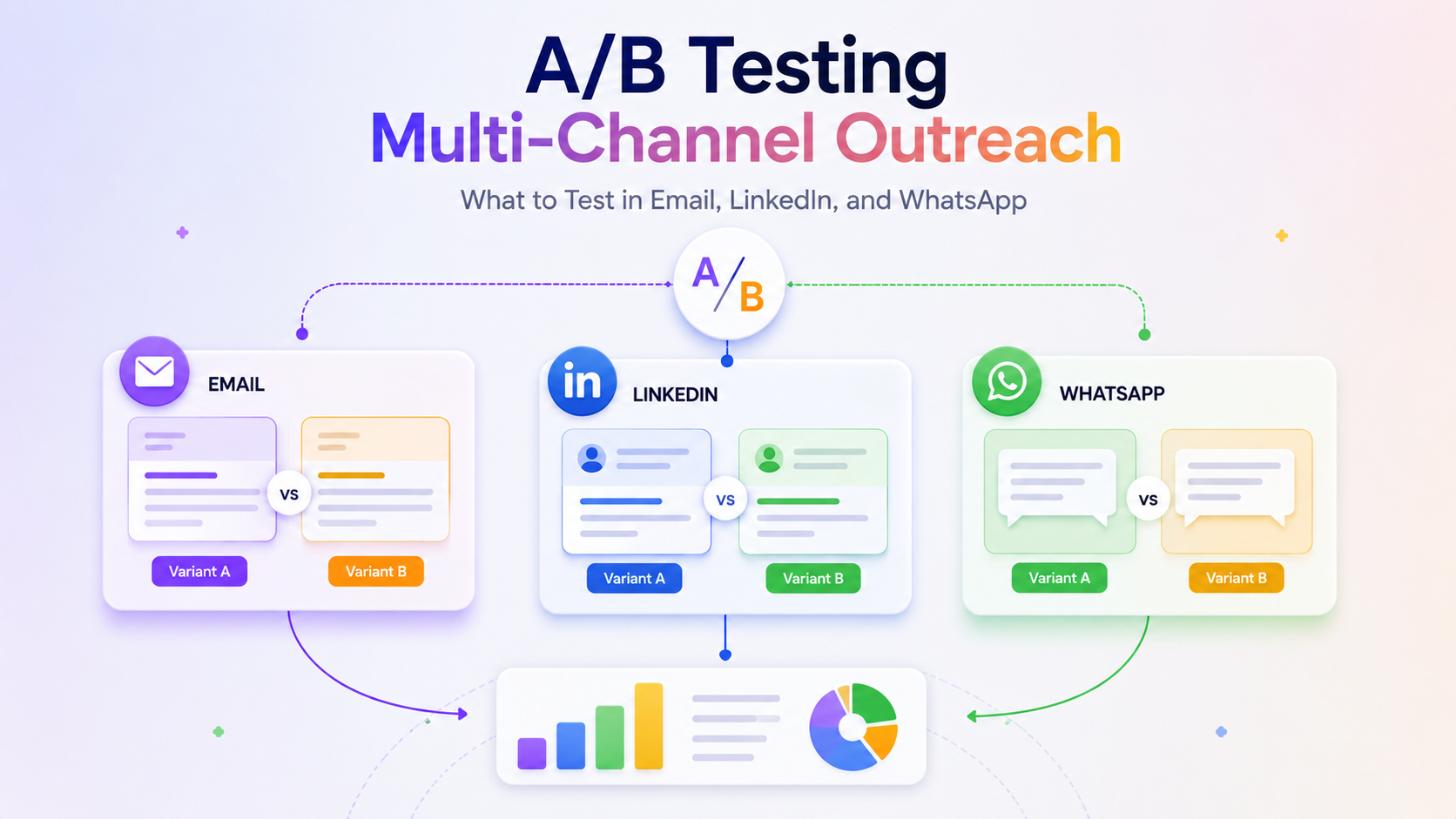

Running A/B tests on multi-channel outreach is harder than testing a single channel. The variables multiply quickly, and most testing guides are written for email only. Subject lines, opening sentences, CTAs. Good advice. But when your sequences run across email, LinkedIn, and WhatsApp at the same time, A/B testing multi-channel outreach requires a different frame. The channel sequence itself is often the variable with the most impact.
Whether you start with email or LinkedIn, how long you wait between touches, whether you reference one channel inside a message from another, these decisions affect reply rates as much as the copy inside any individual message. In 2026, most teams running multi-channel sequences still pick their structure by instinct and never test it.
This guide covers what to test within each channel, what to test at the sequence level, and what consistently wastes time.
The basics of a useful A/B test
Before getting into specifics, three rules that apply regardless of channel.
Test one variable at a time. If you change the subject line and the opening line in the same test, you will not know which one drove the result. Pick the variable you have the strongest hypothesis about and hold everything else constant.
Run enough volume. A test with 20 people per variant will give you a result that means nothing. For most B2B outreach, you want at least 50 contacts per variant before drawing any conclusions. 100+ per variant is where you start seeing patterns you can trust.
Measure the right metric for the goal. Open rate tells you about subject lines and send timing. Reply rate tells you about copy, offer clarity, and channel fit. Meeting booked rate is the only metric that connects to revenue, but it has the most noise and takes the longest to accumulate. Know what you are optimising for before you start.
What to test in cold email
Email is the most documented channel and the one where most teams have baseline intuition. The variables worth testing are narrower than most guides suggest.
Subject lines are the highest-leverage test in email. The difference between a weak and a strong subject line is often a 2x swing in open rate. Keep tests simple: short lowercase versus slightly longer, specific reference versus curiosity gap, name in subject versus no name. One variable per test.
The opening sentence is the second highest-leverage variable. Email clients now show preview text alongside the subject line, so the first sentence functions almost like a second subject line. Test a specific observation about the prospect or their company against a more generic opener. In most ICPs, specificity wins, but the degree matters and it varies.
Your call to action is worth testing once you have reasonable open and reply rates but low conversion to meetings. One clear ask tends to outperform multiple options. "Are you open to a 20-minute call this week?" tends to outperform "Let me know if you'd like to see a demo, hop on a call, or I can send over more info." The soft ask versus direct ask question is genuinely ICP-dependent. Enterprise prospects sometimes respond better to lower-commitment asks.
Send day and time matter less than most people assume once you have reasonable copy. That said, it is an easy variable to test if everything else is already dialled in. Tuesday through Thursday mornings tend to perform better across most B2B segments, but test it for your specific audience rather than taking that as settled.
What to ignore in email: signature format, whether your footer includes a physical address, email thread length, whether you use bullet points versus prose in the body. These have marginal impact at best. The four variables above are where the real work is.
What to test on LinkedIn
LinkedIn has its own testing logic, and most email-testing instincts do not transfer cleanly.
Connection request with a note versus blank. Counterintuitively, blank connection requests often get higher acceptance rates than personalised notes, especially for highly targeted outreach where the prospect can see from your profile why you might be reaching out. Test it for your ICP. The answer is not universal.
Message length. LinkedIn messages that perform well tend to be shorter than cold emails, often two to four lines. But "shorter is better" is not a rule, it is a hypothesis worth testing. Some audiences respond to a slightly longer context-setting message. Test a short, direct version against a medium-length version with more context.
The opening approach. Three options worth testing against each other: opening with a specific reference such as a post they wrote or a company announcement, opening with a direct value statement, and opening with a question. Specific references tend to win on reply rate, but they require more personalisation effort per contact. Test whether the lift in replies justifies the additional work for your volume.
InMail versus connected message. If you are running both, test whether prospects who are messaged after connecting reply at a different rate than InMail-only recipients. In most cases, waiting for a connection before messaging produces higher reply rates, but InMail gives you scale without needing the connection step first.
What to test on WhatsApp
WhatsApp has fewer established conventions for B2B outreach, which makes it both harder and more interesting to test.
Tone. WhatsApp is a personal channel. Formal, structured messages that read like transposed email copy tend to get ignored. Test a conversational opener against a more structured one. In most markets, conversational wins, but what reads as natural in India or Southeast Asia may feel off in Europe. Test your specific market rather than applying a blanket rule.
Message structure. Context-first versus direct ask is the most meaningful structural test on WhatsApp. Some prospects appreciate a brief introduction before the ask. Others prefer you get to the point immediately. This tends to correlate with seniority. Senior buyers often respond better to directness.
Timing. WhatsApp is checked differently than email. Evening messages between 6pm and 8pm local time often see higher open rates than morning messages because the phone is more available outside work hours. But reply rates can be lower if the prospect reads and then forgets to respond. Test open timing and reply timing as separate goals.
Voice notes versus text. This is an emerging test worth running if your team is willing to record short voice messages. In markets where WhatsApp is a primary business channel, a 30-second personalised voice note can generate meaningfully higher reply rates than text. It does not scale easily, but for high-value accounts, the data is worth collecting.
A/B testing your multi-channel sequence structure
The most impactful test in multi-channel outreach is the sequence structure itself, and most teams never run it.
Test email-first versus LinkedIn-first. Some audiences respond better to seeing a LinkedIn message before they receive an email. The LinkedIn interaction primes them. Others find the LinkedIn touch feels more intrusive when it comes first. There is no universal answer, and most teams just pick one without testing.
Test whether to reference other channels in your messages. "I sent you a connection request on LinkedIn" as an email opener can either build credibility or feel aggressive depending on your ICP. Test both versions against a version that makes no reference to other touchpoints.
Test the time gap between channel touches. Same-day multi-channel follow-ups feel pushy to some prospects and feel persistent in a positive way to others. Test a one-day gap against a three-day gap between channel steps and watch where your reply rate lifts across the full sequence.
How toflow.ai helps you run these tests
The challenge with multi-channel testing is that most tools only give you metrics per step, not across the full sequence. You want to see where a prospect first engaged and which path through the sequence produced the most replies.
toflow.ai's sequence analytics shows per-step open and reply rates across email, LinkedIn, and WhatsApp in a single view. You can see whether a drop in replies happened at the email step, the LinkedIn step, or in the handoff between them, and use that to decide which variable to test next. The AI follow-up agent also monitors engagement signals across channels so you can test timing-based variants without building separate manual sequences for each variant.
Frequently asked questions
What is the best tool for A/B testing multi-channel outreach in 2026? Tools that support multi-channel sequences with per-step analytics make multi-channel A/B testing practical. toflow.ai runs email, LinkedIn, and WhatsApp in a single sequence and shows reply rates at each step across all three channels. Lemlist and Instantly are strong for email A/B testing but do not offer WhatsApp as a native outreach channel, which limits what you can test in a true multi-channel setup.
How many contacts do I need per variant to trust an A/B test? For most B2B outreach, 50 contacts per variant is the minimum. Under 50, the result is statistically unreliable. A single good or bad day can skew the numbers. At 100+ per variant you start seeing patterns that hold across different send windows and prospect segments. If your list is smaller than that, run sequential tests over time rather than splitting a small list in half.
What is the most common A/B testing mistake in multi-channel outreach? Testing too many variables at once. Teams often redesign an entire sequence by changing the subject line, opening line, CTA, and channel order all at once, then compare results. When performance changes, they cannot identify what drove it. A useful A/B test is boring to set up. Change one thing, measure the delta, and move to the next variable.
Does A/B testing work differently for WhatsApp compared to email? Yes. Email A/B testing is largely about copy variables such as subject lines, opening lines, and CTAs. WhatsApp testing is more about tone, timing, and message structure. WhatsApp messages are almost always opened, so open rate is not a useful metric there. Focus on reply rate and time to first reply instead.