
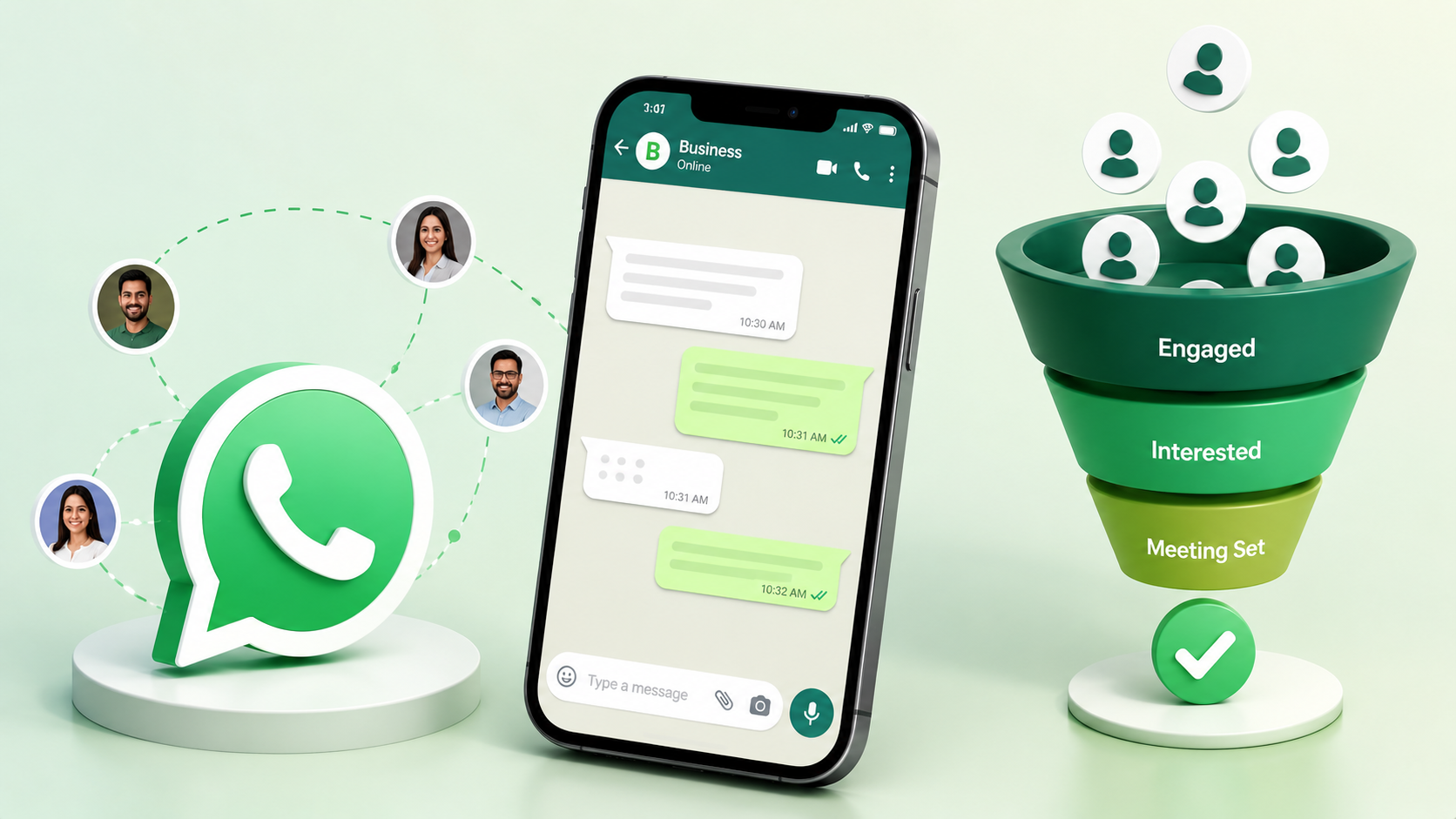

WhatsApp B2B lead generation is the channel most sales teams skip entirely, and the ones who figured it out are seeing reply rates that email has not delivered in years. While the average cold email gets a 3.8% reply rate, well-targeted WhatsApp outreach in the right markets consistently delivers 15 to 20 percent. In India, Brazil, Southeast Asia, and the Middle East, that gap is even wider.
The reason is simple: WhatsApp has a 98% open rate. Messages get read. The question is whether you are there.
Why WhatsApp Works for B2B Lead Generation in 2026
The channel has 3 billion users globally, but that number understates the business case. 284 million businesses now actively use WhatsApp Business, up 42% in two years. In India, 89% of small business owners use WhatsApp for business communication. In Brazil, that number is 91%.
These are not consumer metrics. This is where decisions get made.
For B2B sales teams, the comparison against email is stark:
| Metric | Cold Email | |
|---|---|---|
| Open rate | 20% | 98% |
| Average reply rate | 3.8% | 15-20% |
| Time to first reply | Hours to days | 57% reply within one minute |
The reason WhatsApp delivers at this level is attention. Someone reading a WhatsApp message is on their phone, in the moment. Email sits in a tab. WhatsApp rarely does.
That said, the channel has specific rules. Break them and you will not see these numbers. Follow them and WhatsApp becomes a consistent pipeline source, not a one-off experiment.
Who Should Actually Use WhatsApp for B2B Lead Generation
The channel works best in specific contexts, and it is worth being direct about that before talking about tactics.
Teams selling into India, Southeast Asia, Latin America, or the Middle East should treat WhatsApp as a first-class outreach channel, not a nice-to-have add-on. In these markets, WhatsApp is how professionals communicate. Email is secondary. Decision-makers in these regions often respond faster on WhatsApp than on any other channel.
Sales teams doing high-touch outreach to a focused ICP get more from WhatsApp than high-volume cold outreach shops. The channel rewards specificity. If you are sending the same message to 5,000 people, WhatsApp will burn out fast. If you are reaching 500 well-researched prospects with a message that references something specific to them, the channel converts.
B2B services, SaaS, and consulting businesses with shorter sales cycles see the fastest results. WhatsApp moves quickly. That velocity works in your favor when the buyer's decision does not require a six-month procurement process.
If your prospects are primarily in North America or Western Europe and you sell enterprise software with a long cycle, WhatsApp may work as a supplementary channel but is unlikely to be your primary lead source.
WhatsApp Business App vs WhatsApp Business API: What Sales Teams Need
There are two ways to use WhatsApp for outreach. The right choice depends on your team size and how much volume you plan to run.
WhatsApp Business App is free and works for individual reps doing manual outreach. You get a business profile, quick replies, labels for organizing contacts, and basic automated greeting messages. The ceiling is that it is one number, managed manually, with no integration into your CRM or outreach sequences.
WhatsApp Business API is what teams need at scale. It supports multiple accounts, CRM integration, automated sequences, analytics, and message templating. Access is through official Business Solution Providers or outreach platforms that have built WhatsApp natively into their product.
The setup choice matters because the quality of your infrastructure determines whether you can run WhatsApp at scale without risking account bans. Personal WhatsApp numbers used for volume outreach get flagged quickly. Properly provisioned business numbers through the API do not.
If you want WhatsApp running as part of a multichannel sequence alongside email and LinkedIn, using the API through a platform that manages account health is the right path. Doing it manually through the app does not scale past a few reps.
The Four Rules That Separate Working WhatsApp Outreach From Burned Channels
Most teams that try WhatsApp lead generation and give up broke one of these.
Send to verified contacts who match your ICP. WhatsApp is not for cold blasting a scraped list. The prospects you contact should be mobile numbers you have verified and people who genuinely fit the profile you are selling to. High block rates from poor targeting will get accounts flagged faster than message volume alone.
Keep the first message to two sentences. WhatsApp is conversational. A three-paragraph pitch reads immediately as a template blast and gets ignored or blocked. The goal of the first message is to start a conversation, not close a sale.
No links or files in message one. Links in a cold WhatsApp message look like spam. Files are worse. Lead with a question or a brief observation specific to the prospect. Save anything clickable for after the conversation has started.
Use WhatsApp as one step in a sequence, not a standalone campaign. The best-performing WhatsApp outreach is the third touch after a LinkedIn connection and an email, not the first thing a prospect sees from you. Context from earlier touches makes the WhatsApp message feel like a continuation, not an intrusion.
A WhatsApp B2B Lead Generation Workflow That Actually Works
Step 1: Define your WhatsApp ICP segment. Not every prospect on your list should get a WhatsApp message. Filter for contacts in markets where WhatsApp is a primary business channel, and confirm they have a verified mobile number. Numbers from waterfall enrichment across multiple data sources are more reliable than numbers from general databases.
Step 2: Enrich before outreach. You need a verified mobile number, their current role, and at least one signal that makes your first message specific. That signal can be a recent LinkedIn post, a job change, a funding round, or a shared connection. Enriching this before enrollment means the message is personalized at send time, not merged from a template.
Step 3: Warm the contact first. The most effective WhatsApp sequences start with a LinkedIn connection request a few days earlier. The prospect recognizes your name when the WhatsApp message arrives.
Step 4: Send the first message. Short, specific, no pitch. One question that gives the prospect a reason to reply. Something tied to what you found during enrichment will always outperform a generic opener.
Step 5: One follow-up, then move channels. If there is no reply after four to five days, send one follow-up with a new angle. If still nothing, continue on email or LinkedIn. Two WhatsApp messages without a reply is the ceiling. A third message turns the channel into exactly what WhatsApp users dislike.
Step 6: Handle replies within minutes. WhatsApp conversations move fast. A reply that sits for six hours loses momentum. Routing WhatsApp replies into a unified inbox alongside email and LinkedIn keeps response times fast without requiring a rep to monitor three separate apps.
Realistic Benchmarks for WhatsApp Lead Generation
Numbers to plan against for B2B WhatsApp outreach when the setup is correct:
- First message reply rate: 15 to 25% for well-targeted lists in high-adoption markets
- Follow-up reply rate: 5 to 10%
- Conversion from reply to booked call: 30 to 40% for qualified lists
These benchmarks apply to outreach in India, Southeast Asia, and the Middle East. In Western markets, expect 30 to 50% lower across all metrics.
Businesses that have moved WhatsApp from an ad hoc channel to a structured part of their outreach sequence report 2.4 times higher monthly revenue growth compared to teams not using the channel at all. That gap is not about WhatsApp being magic. It is about reaching people where they actually respond.
Running WhatsApp at Scale Without Burning Accounts
Account limits are real. WhatsApp flags accounts that send too many first messages to unknown contacts, use copy that reads like mass sends, or receive too many blocks from recipients. At volume, account management matters as much as message quality.
Teams running WhatsApp successfully at scale do three things: they rotate sends across multiple provisioned accounts, they keep daily first-message volume per account within safe limits, and they watch block rates as an early warning signal before it becomes an account issue.
toflow.ai's multi-channel outreach sequences include built-in account load balancing for WhatsApp, distributing sends across connected accounts automatically. The follow-up agent monitors engagement signals across channels and handles follow-up timing without a rep tracking each thread manually.
Book a demo to see how the full WhatsApp lead generation workflow runs in practice. Two weeks free, no credit card required.
Frequently asked questions
What is the best way to use WhatsApp for B2B lead generation in 2026? The highest-converting approach combines WhatsApp with LinkedIn and email in a single multichannel sequence rather than running WhatsApp as a standalone channel. LinkedIn establishes the first connection, email provides context, and WhatsApp follows up with a short specific message after the prospect already recognizes your name. Tools like toflow.ai support WhatsApp as a native sequence step alongside LinkedIn and email, so scheduling, personalization, and follow-up run automatically.
Which markets respond best to WhatsApp B2B outreach? India, Indonesia, Malaysia, the Philippines, Brazil, Mexico, the UAE, Saudi Arabia, and Nigeria are the strongest markets for WhatsApp B2B outreach. In these regions, WhatsApp is the primary channel for professional communication and reply rates consistently outperform email. In the US and most of Western Europe, WhatsApp is less common for business use and response rates are lower.
What is the difference between WhatsApp Business App and WhatsApp Business API for sales teams? WhatsApp Business App is a free app designed for individual reps or very small teams doing manual outreach on a single number. WhatsApp Business API supports multiple accounts, CRM integration, automated sequences, and analytics. Sales teams doing any meaningful outreach volume should use the API rather than the app to avoid account restrictions and to connect WhatsApp into their broader outreach workflow.
How many WhatsApp messages should you send to a prospect before stopping? Two. One first message and one follow-up if there is no reply after four to five days. Sending a third message without a response significantly increases block rates and can get accounts flagged. If a prospect has not engaged after two WhatsApp messages, continue the sequence on email or LinkedIn rather than persisting on WhatsApp.
Can WhatsApp B2B outreach be automated? Yes, through the WhatsApp Business API and outreach platforms with native WhatsApp support. Automation handles message scheduling, personalization from enriched contact data, follow-up timing, and reply routing. toflow.ai supports full WhatsApp automation as a native channel alongside email and LinkedIn, including AI-generated personalization per prospect at enrollment and automated follow-up sequencing based on engagement signals.
Does toflow.ai support WhatsApp for B2B outreach? Yes. WhatsApp is a native channel in toflow.ai, not a third-party integration. Sequences can include WhatsApp, LinkedIn, and email steps in a single workflow, with AI-generated personalization per prospect at enrollment. The platform supports multiple connected WhatsApp accounts with automatic load balancing to keep send volumes within safe limits per account.